


Dashboard-Resources-MCAT-Online-INST
Our program is designed for your complete MCAT preparation. You’re getting access to expert instructors, top-notch textbooks, a huge amount of printed and online practice material, two complete sets of Diagnostic Exams, full-length practice tests, access to a state-of-the-art learning software called smart practice technology, access to a huge library of content-specific videos, as well as access to the practice materials from the AAMC (as they are available).
As a first step make sure to watch our Course Introduction video before getting started on any coursework or practice exams. Once you've watched the video take a look around your dashboard, get to work, and prepare to dominate the MCAT!
🚩 MCAT Ultimate Course Introduction 🚩
Questions about your program? Please e-mail our MCAT Administrative Team to get assistance!
Happy studying, and good luck!
Before your class starts, you should:
- Make sure you have your materials kit | If you enrolled more than 10 days before your first class and the kit hasn't arrived, inform customer service. See below to download PDFs you can use until that box shows up.
- Get to know your program | Familiarize yourself with your materials and our approach by reading through the information on this page and watching the Lecture Zero video.
- Basic MCAT information
- An overview of your materials
- Some subject-specific nuances and study strategies
- MCAT Student Guide | This document contains key MCAT information, information about diagnostic exams, practice tests, smart practice technology, MedFlix, a basic study/test schedule, and more.
- Take the first set of Diagnostic Exams | There are six of these and will take up to an hour each to complete. Set aside 3-5 days to accomplish this. For more information on the Diagnostic Exams, see the section titled Information about Diagnostic Exams.
🚩 Lecture Zero 🚩
Your program comes with access to full-length online MCAT Practice Tests written by The Princeton Review. The TPR-written tests include TPR Course Tests, TPR Free Demo Practice Test, MCAT Review Series Practice Tests, and TPR MCAT Practice Tests. You may take any of these tests as many times as you wish—you can find them on the “Practice Tests” tab of this dashboard.
At minimum, you should take five practice tests, called Core Tests. The Core Tests include TPR Course Tests 1-5. The Core Tests should be taken at regular intervals, spread out over your program. You should take TPR Course Test 1 early on in your course. Then, continue taking a Core Test every 1-2 weeks thereafter. Your final test should be the AAMC Practice Test, and taken about one week prior to your actual MCAT test date.
While taking the five Core Tests is the minimum, many students like to take more practice tests than that, and we encourage this. Feel free to insert more practice tests in between the Core Tests—your options will be listed under “supplemental tests” on the Practice Tests tab.
In between taking practice tests you should work on your strategy using smart practice technology, the Science Workbook passages, the CARS Workbook passages, and the online Practice Passages. Make sure to target your personal areas of weakness, as determined by the Diagnostic Exams. Talk to your teacher for more information.
More Information about Taking Practice Tests
Diagnostic Exams are NOT Practice Tests. Here are some quick definitions:
MCAT Practice Test: a test designed to mimic the actual MCAT, to give you practice with the mechanics of the test and the type of questions you will see. All subjects are included in the test, but because of the limitations on the number of questions that can be asked, this is NOT content-comprehensive. You have 11 full-length practice tests available to you.
MCAT Diagnostic Test: a test designed to assess your areas of strengths and weaknesses in a particular MCAT subject. This is a subject specific test, and the number of questions is much higher so that all content (or question types) is tested. For example, each set of Biology Diagnostic Exams include a total of over 150 questions that cover the breadth of all the Biology content tested on the MCAT. This IS content-comprehensive.
More Information about Taking Diagnostic Exams
There are a total of 19 Biology modules, 13 General Chemistry modules, 5 Organic Chemistry modules, 26 Physics modules, and 6 Psychology and Sociology modules (totaling over 1,400 questions!). In addition, there are sets of primer questions for you to answer prior to each science lecture. The questions are designed to prime you for the content covered in each class session; to get you thinking about the material before you walk into class. These primer sets are very short (about 6 questions each) and cover the content that will be discussed in that lecture. There are no solutions provided for these questions; you will uncover the answers to them as your instructor lectures.
You can also access smart practice technology modules via an app on your smartphone. This app will sync with the content accessible via your online student tools. For more information, download this document. MCAT Prep To Go.
What is the AAMC CARS Diagnostic Tool?
The AAMC has created a CARS Diagnostic Tool to help students identify and work on their strengths and weaknesses in the CARS section. The main value of the tool is that it provides additional practice material directly from the AAMC test writers. The explanatory videos may give you some insight into how to track an author’s argument in the passage text. The written and video explanations are useful to understand why answers are right and wrong; keep in mind, however, that the question explanations are NOT consistently modeling or explaining strategy.
To get the most out of the AAMC Diagnostic Tool score reports, first use their assessments to see if you are missing more questions in one or two of the three AAMC question type categories (Foundations of Comprehension, Reasoning Within the Text, and Reasoning Beyond the Text). Then break those questions down into the ten TPR question types and three formats. Finally, compare those results to the Self Evaluation Passage Logs and Test Assessment Logs you are doing for your assigned Coursework passages and tests. The more data you have, the better you can recognize what is leading you to wrong answers and what you can do differently in the future in order to improve!
More information about the AAMC CARS Diagnostic Tool
The MedFlix videos are your content lessons for your course.
All of the MCAT lectures were broken down into 5-15 minute segments and recorded to create a library of content videos. These videos are available on your coursework page associated with their specific lecture. The videos can be used in three different ways:
- To preview specific content topics before lecture. Maybe it’s been a while since you’ve seen DNA replication, and just want a quick preview before class. In some cases, it’s helpful to watch videos before class because they aren’t going to be included in lecture, for example, there are two MCAT Math videos that are helpful to watch before Physics 1, and there are several Statistics videos the content of which will not be discussed during lecture.
- To review or refresh content after lecture. Maybe you had to step out of class for a moment and missed something, or maybe you didn’t quite get it the first time and just need to see it again. You can watch – and pause! – these videos as many times as you like.
- As make-up lessons if you miss class. You should always try to attend class to get the most benefit from your course, but occasionally something might come up and you have to miss lecture. You can watch the content videos to learn the material you missed in class. Note however, that the ICC passages are not discussed in the content videos; you’ll have to do those on your own and ask you instructor(s) if you have any questions about them. Also, watching the content videos does not count as class attendance for the course guarantee.
MedFlix CARS Practice Drills
The practice passages and drills covered in the MedFlix videos are located in the CARS Review. However, the title in the video is not the same as the title in the book. Here is a list of the video drill titles, and the corresponding location of that material in the CARS Review.
Note: The In-Class Compendium passages covered in live classes are not included in the Medflix videos.
MedFlix CARS Passage Drill I: The Six Steps in Action is located in CARS Review Chapter 2, Practice Passage 2, pp. 52-53
MedFlix CARS Passage Drill II: Active Reading is located in CARS Review Chapter 4, Practice Passage 1, pp. 176-177
MedFlix CARS Passage Drill III: Answering in Own Words is located in CARS Review Chapter 8, Exercise 6 Passage I, pp. 302-303
MedFlix CARS Passage Drill IV: Attacking the Questions is located in CARS Review Chapter 9, Practice Passage 1, pp. 336-337
MedFlix CARS Passage Drill V: Annotating POE is located in CARS Review Chapter 8, Practice Passage 2, pp. 326-327
MedFlix CARS Skill Building Drill: Passage Ranking Exercise is located in CARS Review Chapter 6, Passage Ranking Exercise, pp. 226-227
MedFlix CARS Passage Drill VI: Ranking and Pacing is located in CARS Review Chapter 6, Practice Passages 1 & 2, pp. 234-237
MedFlix CARS Passage Drill VII: 5 Minutes Left is located in CARS Review Chapter 7, Exercise 2 “5 Minute Drill,” pp. 258-259
MedFlix CARS Passage Drill VIII: Solidifying Your Strategy 1 is located in CARS Review Chapter 7, Practice Passage 1, pp. 272-273
MedFlix CARS Passage Drill IX: Solidifying Your Strategy 2 is located in CARS Review Chapter 9, Practice Passage 2, pp. 338-339
Click here to open a new window that contains any and all known materials updates.
Sometimes students enroll in our MCAT course at the last minute and do not receive their materials before the first day of class. Links to download or view the full 2016 In-Class Compendium and the full texts of the Science and CARS Workbooks in PDF format are provided below. In addition you will find links to the full version of the MCAT Biochemistry Review and the first few chapters from the rest of the books in the 2016 MCAT Review series. This will allow you to complete your reading and homework until your books arrive, which should occur in the next couple of days.
The six books in the Review series are your textbooks for the course. Your reading assignments and some homework assignments come from these books. In addition, the In-Class Compendium contains practice passages used during lecture, and the Science and CARS Workbooks contain more passage-based homework. Finally, the Science Review Questions and Solutions pamphlet includes free response questions to test your basic understanding of MCAT science topics; you can use this to review when you are near the end of the course. You will see your schedule of lectures under Classes on your Dashboard. Consult this schedule and the MCAT Student Guide (posted throughout the dashboard), to see what you should read prior to class.
For some of the MCAT subjects, you will need to print out an In-Class Compendium passage or two to bring with you to class:
| Biology | ICC passages 1-5 (1-3 for Lecture 1 and 4 & 5 for Lecture 2) |
|---|---|
| General Chemistry | ICC passages 1-6 (1-3 for Lecture 1 and 4-6 for Lecture 2) |
| Organic Chemistry | ICC passages 1-5 (1 & 2 for Lecture 1 and 3-5 for Lecture 2) |
| Physics | ICC passage 1 (no passage for Lecture 1, and 1 for Lecture 2) |
| Psychology and Sociology | ICC passages 2-4 (2 for Lecture 1 and 3 & 4 for Lecture 2) |
| Critical Analysis and Reasoning Skills | ICC passages 1-4 (1 for Lecture 1 and 2-4 for Lecture 2) |
All of the content below is in PDF form, so you will need Adobe Reader to properly interact with it.
- 2020 In-Class Compendium
- 2016 In-Class Compendium
- 2016 Science Workbook
- 2016 Science Review Questions and Solutions
- 2016 CARS Workbook
- 2016 Biochemistry Review
- 2016 Biology Review, Partial
- 2016 General Chemistry Review, Partial
- 2016 Organic Chemistry Review, Partial
- 2016 Physics and Math Review, Partial
- 2019 Psychology Sociology Review, Partial
- 2016 CARS Review, Partial
This section includes PDF documents of a number of things so that you can easily access and /or print them as needed.
- MCAT Student Guide This document contains basic MCAT information, information about diagnostic exams, practice tests, smart practice technology, a basic study/test schedule, homework descriptions, and more. Start with this document!
- MCAT Advice This document contains recommendations to students about how to prep for the MCAT.
- TPR Classroom Best Practices & Troubleshooting Here is a guide with some best practices and troubleshooting tips for taking an online class with The Princeton Review:
- AAMC Official MCAT Sample Test Solutions This document contains solutions to all of the questions on the AAMC Official MCAT Sample Test.
- Question Review Worksheet The Question Review Worksheet is a useful tool for analyzing your performance on a practice passage or on an entire section of a practice test.
- Supplementary Genetics Problem Set
- Supplementary Genetics Problem Set Answer Key The Supplementary Genetics Problem Set includes some additional problems in genetics, both solving general probability questions as well as pedigree analysis. There is an answer key that goes along with the problem set as well.
- CARS Question Type Summary
- CARS MAPS Log
- CARS Individual Passage Log
- CARS Test Assessment Log The CARS Logs (MAPS Log, Individual Passage Log, and Test Assessment Log) can help you analyze your performance on single CARS passages and the CARS section overall. Your CARS Instructor will give you more information on how to use these logs.
Before Your First LiveOnline Session
Ensure your computer is ready to interface with our virtual classroom!
How to Join a Session – Classroom Launch Links
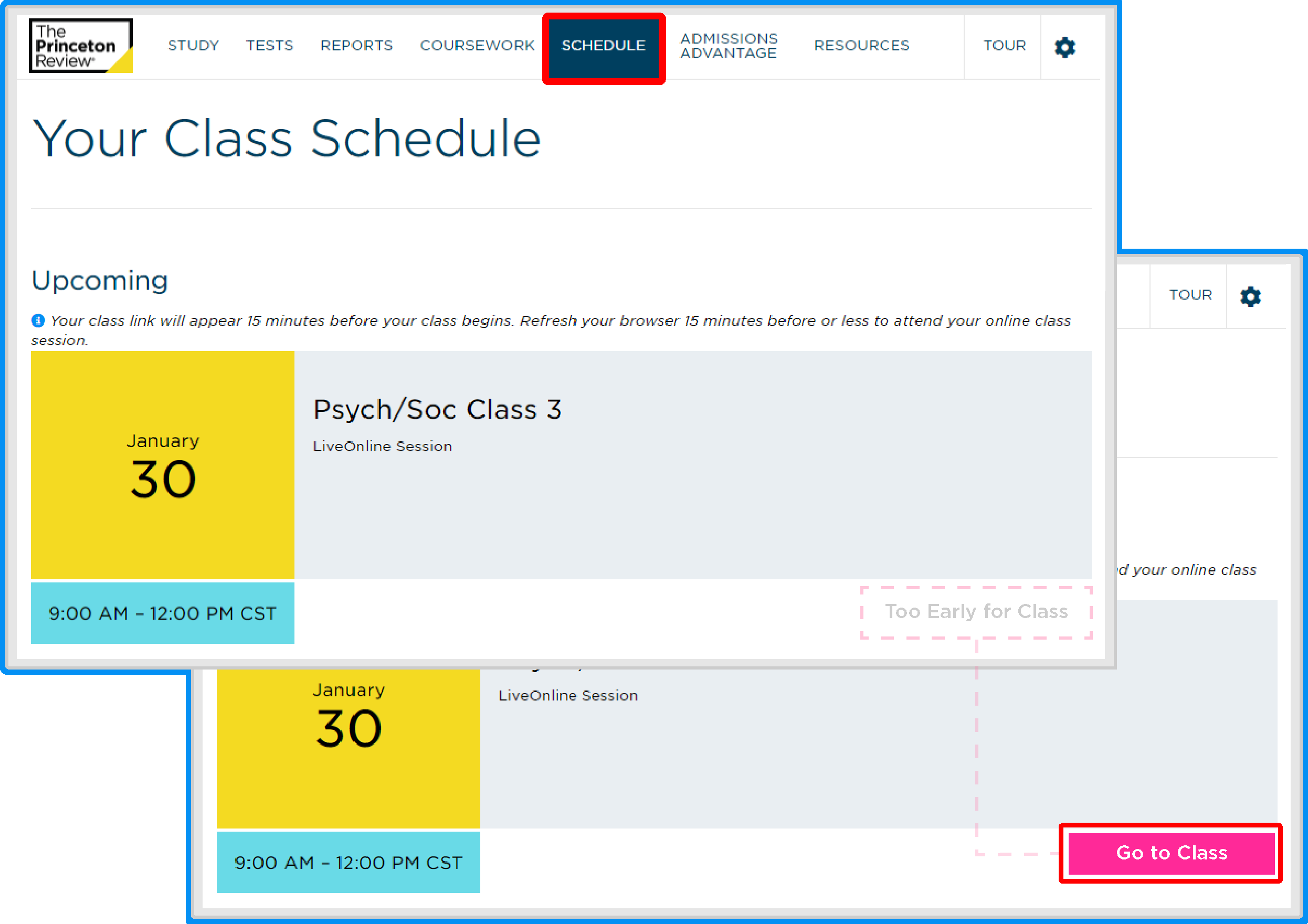
With 41+ sessions across 6 subjects, becoming acquainted with your MCAT course's schedule is key! While it's no surprise that your schedule is found on the "Schedule" tab, however from this screen, you can find your Classroom launch links . Have no fear, 15 minutes before the start of your scheduled session, your launch links will appear!
Topic Focus Sessions
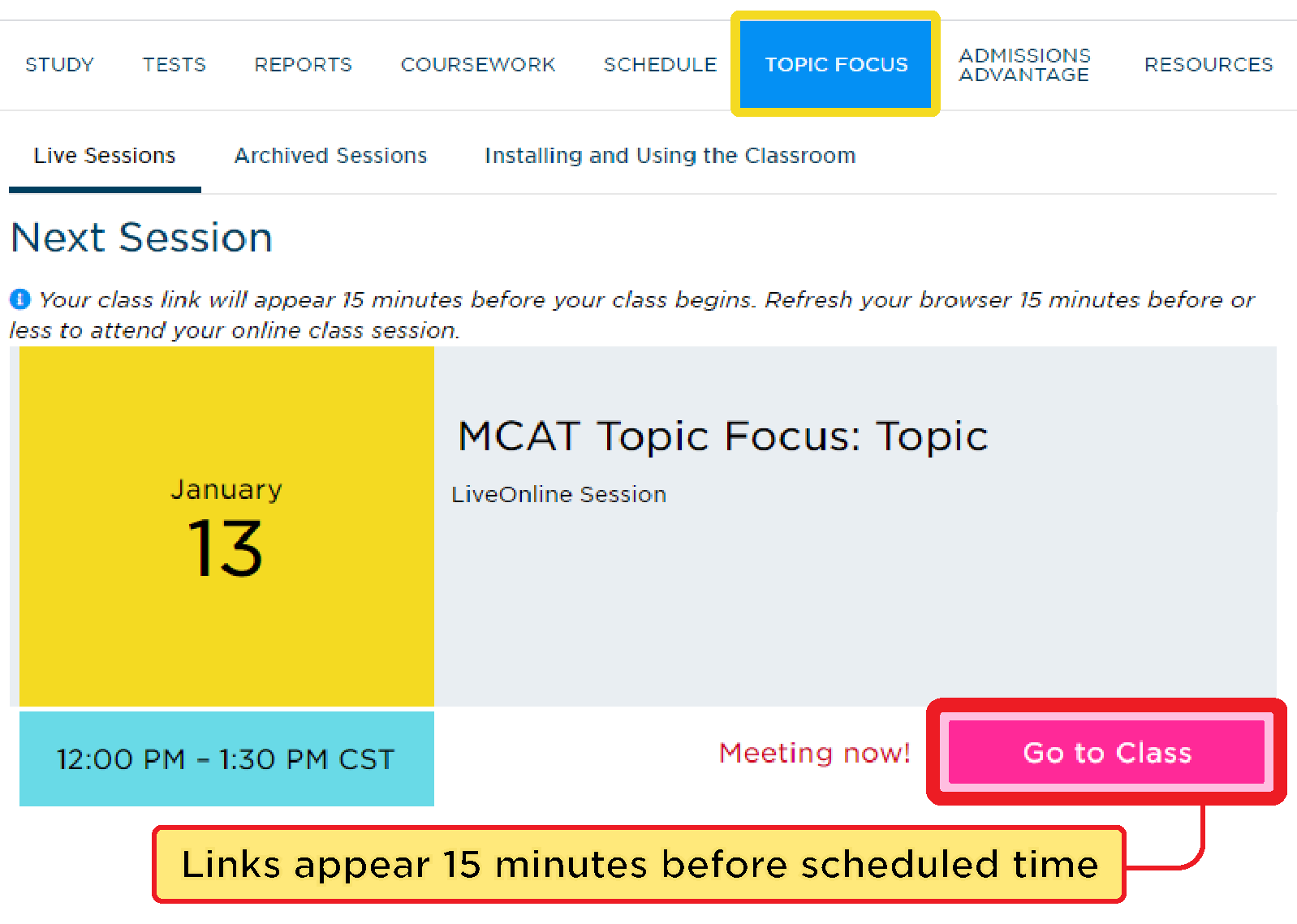
For students enrolled in our 510+ Guarantee courses, our MCAT Topic Focus sessions meet in the same classroom environment as all regularly scheduled Ultimate class sessions. Classroom launch links are available in the ‘Live Sessions’ tab of the ‘Topic Focus’ section of your Student Portal. The link becomes active 15 minutes before the scheduled start time.
🚩 First Time Users:
- Google Chrome is required – Ensure that your Google Chrome browser is updated.
- Don't use Google Chrome? Download it HERE
- Regularly clear cache and temporary files as outlined in the Troubleshooting Guide highlighted below
⭐ Troubleshooting Guide ⭐
- Find Support Here
- If this document is not solving your issue, please call the support line.
Want to learn more about medical schools? We’ve got the answers. Here are a few places to research schools , get advice , and even learn about study abroad programs ! You can even learn some helpful MCAT Memorization Tips.
 Opt-Out Signal Honored


